

Piet Oudolf’s New Wave Gardens
One of the foremost exponents of modern landscape design is Piet Oudolf, a Dutch architect and gardener whose work is considered an impressive example of modern creativity in this field. Over the past 25 years, his influence in the world of garden design has been undeniable. Oudolf, as well as several other European landscape architects, together created a new movement in landscape architecture, which they called the “New Wave”. They described in detail the features of their approach in books and demonstrated it in the implementation of various projects.
Piet Oudolf’s Garden Principles
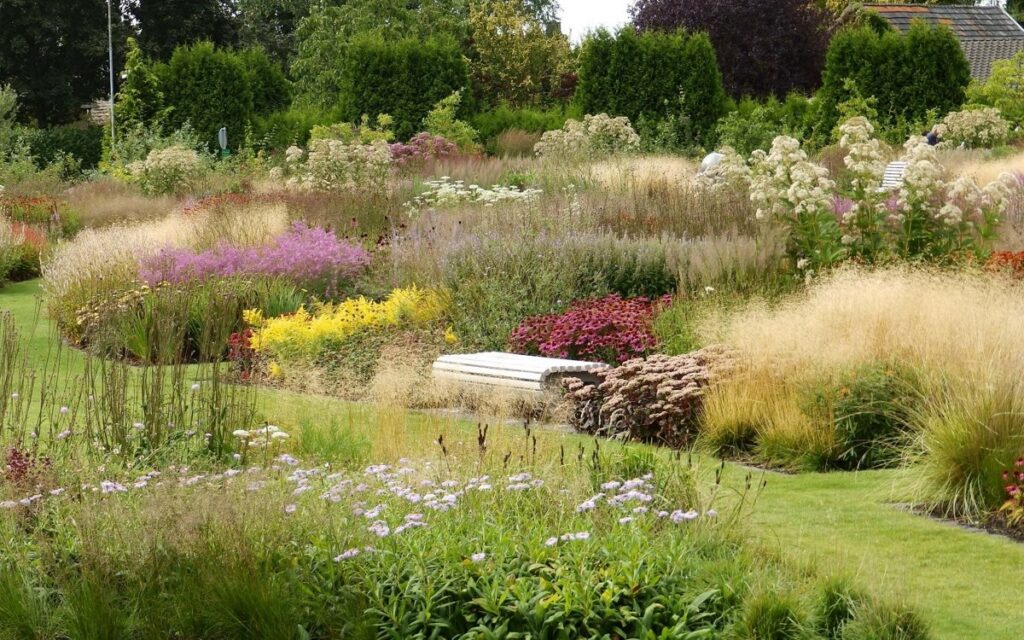
The Piet Oudolf style works by emphasizing structure, form and texture over color. Oudolf recommends not creating a garden focusing solely on color spots, like “there will be purple here, there will be red here.” Instead, it is preferable to first identify and distribute plant shapes, and then decide which colors will best suit those shapes. In his work, Oudolf classifies plants according to their shape. This does not mean that flowers play a secondary role, given that they are not always in bloom. For example, plants that create vertical structures or crenellations may include not only flowering plants such as foxgloves and sage, but also tall, narrow grasses that can grow vertically. On the other hand, plants that form screens and curtains can include not only grasses like meadow grass, but also tall, thin plants such as fennel or verbena that create flowering beds on tall stems, giving a sense of height without obscuring while viewing from behind. The same approach applies to color schemes, taking into account not only flowers, but also grasses and leaves that can produce the desired color effect.
Piet Oudolf and his followers adhere to the guiding principle that the structure, form and texture of plants are given more importance than color. They advise not to focus on color when creating a garden, but to concentrate on the shapes and structure of plants, and then choose color schemes. Oudolf classifies plants according to their forms, noting that some plants form vertical elements while others create screens and curtains. This approach also applies to color solutions, where it is important to take into account not only the color of flowers, but also the colors of leaves and herbs.
What plants are used in New Wave gardens and flower beds?
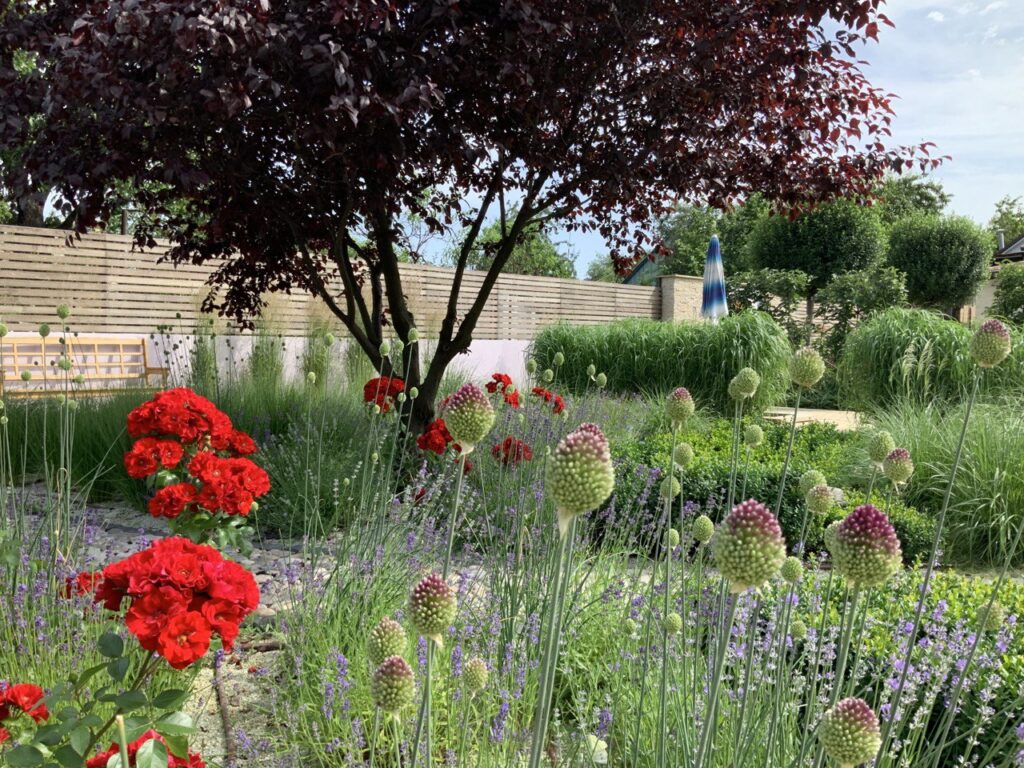
Perennials are preferable to trees and shrubs because they are constantly changing while maintaining an attractive appearance. It is important to consider the shape of the plant throughout the year, including their structure even during winter when stems may become brittle and die. When choosing plants, it is also important to consider their climate tolerance and their ability to spread without harming the environment. This approach creates a natural and abundant garden appearance where plants can grow in harmony with each other without the need for frequent interventions.
Plants may require some care, such as thinning, mulching and fertilizing, but the main goal is to create a composition of plants that can reach their full potential in specific climate and soil conditions without being harmed by diseases and pests.
The main goal of New Wave gardens is to create an atmosphere of complete peace, comfort and freedom in the garden. In this style, original decorative bushes trimmed in geometric shapes, as well as various traditional garden decorations, are not welcome. Instead, the emphasis is on plants taken from the wild that complement each other harmoniously.
To create a natural style, exotic plants are not required, but rather simple and perennial plants such as grasses, perennial herbs and bulbs are used. The uniqueness of this style is that the garden looks attractive even after all the plants have bloomed.
The composition of a New Wave garden is usually based on perennials with “daisy-like” forms, as well as milkweed, sedum and phlox. To create height in the composition, plants such as maquea, katran and cephalaria are used, and volume is given by cereals and umbrella plants.
The advantage of the New Wave style is its durability, low cost and minimal maintenance requirements. To maintain this style of garden, mulching the soil and removing self-seeding is sufficient. The main aspect in creating such a garden is the harmonious combination of plant shapes and silhouettes, and not the color palette.
In most New Wave gardens, colors are chosen in pastel tones, such as various shades of green, linden, silver gray, gold and lilac, without using bright reds, blues or yellows. This color combination is calming, inspiring and relaxing.
As for the shapes and silhouettes of plants, in the New Wave gardens preference is given to such forms as “baskets”, “umbrellas”, “balls”, “daisies”, etc. The unique shapes of flower beds make them attractive throughout the year , despite the fact that it is almost impossible to create a continuous line of flowering in such a composition.
As already noted, the basis of a New Wave flower garden is made up of perennials with small flowers to give a feeling of lightness. Among such plants are chamomile (Matricaria recutita L.), purple coneflower (Echinacea purpurea (L.) Moench.), astilbe (Astilbe Buch.–Ham. ex D.Don) and yarrow (Achillea millefolium L.).
Among deciduous plants, preference is given to macleaya cordata (Willd.) R.Br., miscanthus (Miscanthus Andersson) and ligularia (Ligularia Cass.). As for “umbrellas” and “candles,” such plants include mullein (Verbascum L.), foxgloves (Digitalis L.) and saplings (Eupatorium L.).
The calling card of the New Wave style is cereals. The soft green shades of their panicles and spear-shaped leaves serve as a smooth transition from one type of plant to another. Even in winter, dry stalks of cereals look beautiful from under a layer of snow. However, the problem is that they can crowd out other plant species, so it is important to dig agrofibre around their rhizomes when creating the composition.
Where is it recommended to create a New Wave garden?
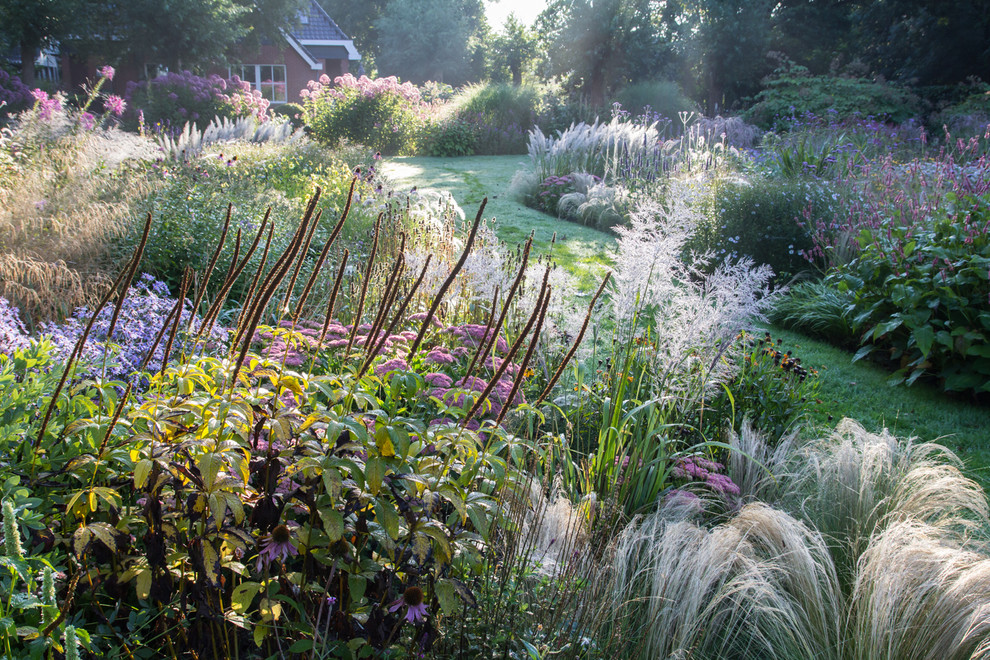
As for the background on which the plants are located, the ideal option would be a garden or a woodland. If the garden plot is small and the composition is placed within the fence, you can decorate the fence with a hedge.
Another important aspect when choosing a location for a garden in the New Wave style is insolation. If the sun’s rays fall on the site obliquely, the beauty of the garden will not be fully revealed. Therefore, the ideal place for plants would be the southwestern or western part of the site.


