

Gabions in landscape design
The use of gabions in landscape design
Today, gabions are a popular tool in the modern construction and design industry. They are an effective solution for the design and improvement of sites, as well as creating a harmonious landscape design. Gabions consist of a metal frame filled with a variety of rocks and possibly other materials. In landscape design, gabions offer a variety of shapes and sizes, which are selected depending on the style of the territory.
The history of gabions begins in the ancient world, where they were used mainly to create defensive structures. These were wicker baskets filled with earth or stones. Then such designs began to be actively used in European countries. Engineers used them in the construction of bridges and other important structures where high reliability of the elements was required. Mesh structures filled with stones and other materials then found wide application in landscape design and gained great popularity. Gabions are affordable and easy to use compared to alternative solutions.
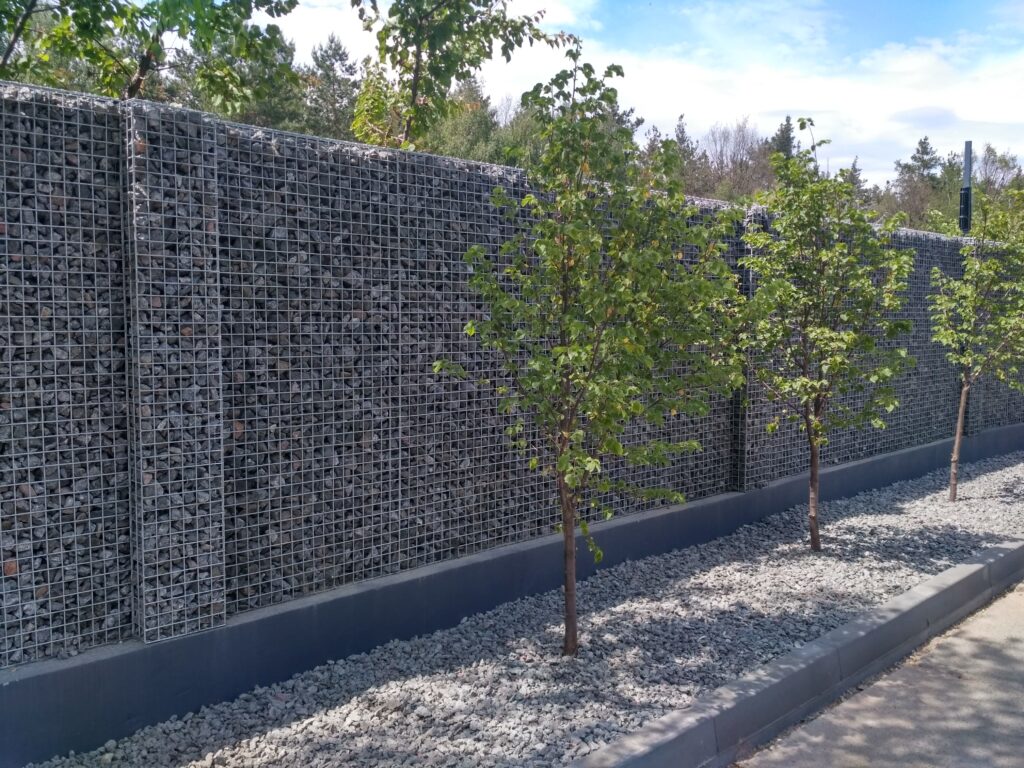
The use of gabions in landscape design
Gabions are often used by landscape designers to decorate client sites, as they are attractively shaped to create the desired style and complete the decoration of the space. Due to their decorativeness and functionality, these structures are highly durable and last a long time. They are resistant to temperature extremes, precipitation and various mechanical influences.
Gabions are widely used in landscape design. They are used to strengthen embankments, reinforce soils, erect various structures, protect running tracks and other purposes. In modern landscape design, such mesh stone structures are used to aesthetically design areas. Gabions are used for:
- Creating corners on the site with the appropriate texture, corresponding to the style;
- Creating a harmonious color palette in the decorated area;
- Structural support of retaining walls;
- Emphasizing the stone foundation of the house;
- Creating an attractive garden around the house;
- Construction of stylish benches for a site outside the city;
- Construction of special sites for secluded gatherings. They are usually installed next to windows and serve as a kind of screen without disturbing visibility and letting in enough light;
- Creation of figurines;
- Use as flower pots;
- Creation of the basis for rockeries;
- Construction of arches and other types of partitions.
Today, there is no problem in selecting suitable gabions for any of these purposes, which will be in harmony with the general style of the site and the landscape design of the surrounding area.
When installing gabions, site designers should take into account the size and shape of the surrounding space. The choice of structures of the required size depends on this. Depending on this, the filling is also selected. Stones are not always the filling material. Bricks, concrete mixtures are often used. To install the structure, it is necessary to choose a flat surface and lay out a metal mesh on it. Then it is filled with the selected material. To fix all the elements, special brackets, wire and other auxiliary elements are used. Installation may seem simple, but it has several important nuances to consider:
When using stones, it is important that there are no gaps between them in order to avoid deformation of the structure;
If bricks or concrete blocks are chosen as filler, good drainage must be provided to avoid negative consequences. If a metal structure becomes rusty, it may not last long.
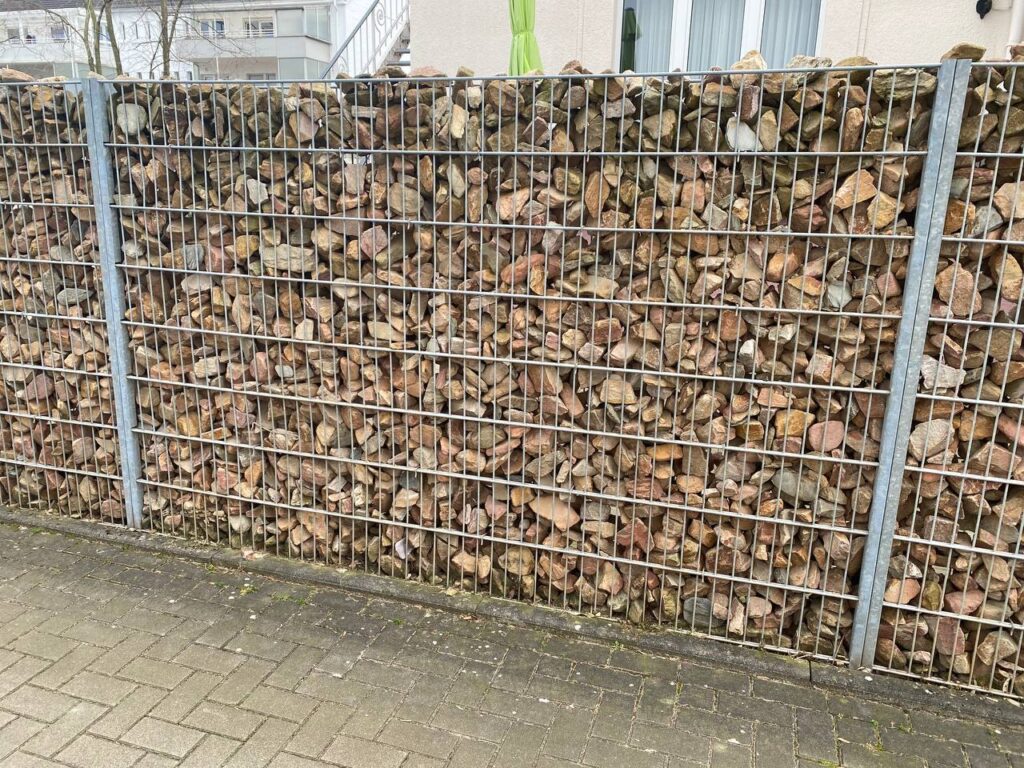
Types and types of gabions
In landscape design, there are three main types of gabion structures that are widely used in the art of space design. When choosing gabions for a project, landscape designers strive to find solutions that are in harmony with the environment in terms of shape, size and other characteristics.
The first type is box gabions. Their shape resembles a parallelepiped and usually decorative objects up to 4 meters long, up to 1 meter wide and up to 1 meter high are used. If the length exceeds 2 meters, baffles are installed inside the box to ensure stability when using various fillers. Such gabions are used as supporting walls or to create solid foundations.
The second type is mattress gabions. They got their name from their mattress-like shape. The width of such gabions is usually about 2 meters, and the length is at least 6 meters. The height is minimal and is approximately 30 centimeters. To increase the durability of such gabions, membrane partitions are installed inside every meter. Mattress gabions are ideal for reinforcing ravines, banks and other places, and their shape makes them easy to install and saves filling materials.
The third type is cylindrical gabions. This type of gabion gets its name from its shape, resembling a cylinder or candy bar. The length of cylindrical gabions is about 4 meters, and the diameter usually does not exceed 95 centimeters. Unlike other types, cylindrical gabions do not require the installation of additional partitions, which makes them more flexible. This type of gabion provides more opportunities for decorative design on the site due to its shape.
The choice of materials for gabions in landscape design is currently very diverse. The main element is a wire mesh, which can be made of various materials with different strengths. This choice is due to the purpose of the design. Gabions can be used for decorative purposes, props or reinforcements.
The mesh for gabions exists in several versions. Simple solutions are good for basic structures, but if you are looking for a stronger and more durable structure, it is recommended to choose a mesh with double twisted wire. Another option is welded solutions, which are particularly durable. The frame plays an important role in the overall strength of the gabion, since its deficiency can lead to the structure losing its shape or reducing its functionality.
It is important to choose the right material and type of mesh so that the gabion meets the requirements and performs its functions in the best possible way.
Materials for gabions
Various materials can be used as fillers for gabions. It is important that they are strong enough, have an attractive appearance and contribute to the main functions of the structure. When choosing the filling, the dimensions of the holes in the mesh should be taken into account so that the material remains inside. Some of the suitable filler options include:
- River pebbles;
- Suitable size stone
- Basalt;
- Quartzite and other similar materials.
Gabions have many advantages and advantages, due to which they are widely used in landscape design. Some of the main benefits include:
- The ability to qualitatively decorate the site without requiring significant costs;
- There is no need for special equipment for installation;
- No need to install a drainage system, as the gabion structures themselves cope with moisture;
- Durability even when exposed to various weather conditions such as temperature changes, rain and snow;
- Possibility of use in various styles of landscape design. Gabions, usually made of galvanized mesh and natural
- materials, organically fit into any surrounding space;
- Great for creating a shadow screen in hot climates;
- Environmental component, since recycled materials can be used to fill gabions;
- High strength structures, which makes them resistant to various natural disasters.
Gabions are popular designs that combine decorative and functional properties. They have a variety of shapes and can be used in areas with different characteristics. Gabions are used to decorate various objects in order to create a harmonious look of the environment. When choosing gabions, it is important to pay attention to their shapes, sizes and materials in order to choose the most suitable for a particular project.


